
How to Evaluate Aluminum Foil Container Machine Suppliers: Factory, Trader or Integrator?
If you search for "Aluminum Foil Container Machine" on Google or B2B platforms, you will find thousands of suppliers. They all claim to be "Leading Manufacturers," use the same stock photos, and promise the lowest prices.
For an overseas buyer, the challenge is not finding a supplier—it is filtering the noise. Are you talking to a real factory, a trading company, or a system integrator?
Choosing the wrong partner leads to nightmares: spare parts that never arrive, engineers who ghost you when the machine stops, or receiving a machine that looks like the photo but fails to run at speed.
This guide is written from the perspective of an engineering team. We will show you exactly how to audit a supplier effectively, ensuring your investment is safe.
Types of Suppliers in the Market
Before you send an inquiry, you must identify who is on the other side of the screen.
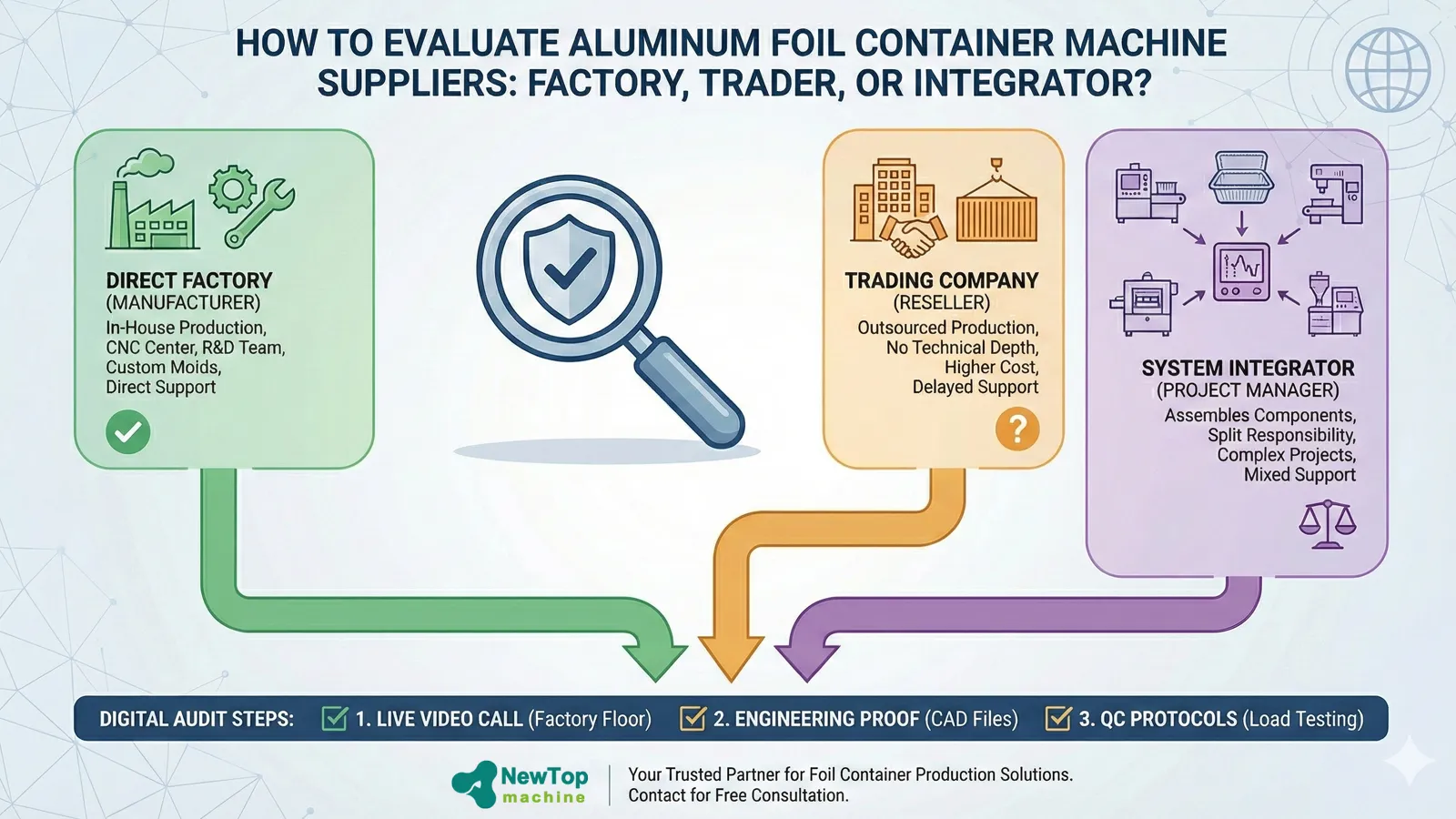
1. Direct Manufacturer (The Factory)
These companies own the CNC machines, employ the assembly workers, and write the PLC code. They have full control over production and pricing.
Pros: Direct technical support, lower long-term spare parts cost, custom modifications.
Cons: MOQ (Minimum Order Quantity) might be higher; sales teams may be less "polished" than traders.
2. Trading Company
They do not manufacture anything. They buy from factories and resell to you.
Pros: Good English, low MOQ, can consolidate shipments of different products.
Cons: No technical depth. If your machine breaks, they have to ask the factory, adding days to the delay. Price includes their margin.
3. System Integrator
They act as project managers. They might buy the press from Factory A, the mold from Factory B, and the stacker from Factory C, then integrate them.
Pros: Good for complex, turnkey projects.
Cons: Responsibility is split. If the mold breaks, they might blame the press manufacturer.
Key Questions to Ask Before Choosing
Don't just ask "How much?" Ask these "Trust-Check" questions to reveal their true nature.
-
"Can I have a video call to see the live production floor right now?"
A real factory will say yes. A trader will make excuses or show you a showroom (which might not be theirs). -
"Who designs your molds?"
The mold is the heart of the machine. If they outsource mold making to a cheap third party, you will struggle with Mold Maintenance later. Real manufacturers have in-house CNC centers. -
"What is the brand of your PLC and Inverter?"
Force them to be specific. If they say "Famous Chinese Brand," be careful. Look for Siemens, Delta, or Mitsubishi—brands with global support.
How to Verify a Real Manufacturer
You don't need to fly to China to verify a supplier. Use these digital audit steps:
- The Background Check: Look closely at their "About Us" photos. Do the workers' uniforms match the company logo? Do the machines in the background have the company nameplate?
- The Engineering Proof: Ask for a drawing of a specific part of the machine. Only the manufacturer has the original CAD/SolidWorks files. Traders only have PDF brochures.
- The Stock Video: Ask them to film a piece of paper with today's date next to the machine you are interested in.
Customization Capability: The Ultimate Test
Real manufacturers thrive on customization; traders fear it.
Ask if they can modify the Electrical System to meet your local safety standards (e.g., UL for USA, CE for Europe). Ask if they can design a mold for a unique container shape.
If their answer is a hesitant "we will try" or an immediate "no," they likely lack an in-house engineering team. A factory with strong R&D will discuss feasibility, not just say yes/no.
Quality Control: Beyond the Visuals
A shiny paint job doesn't mean a stable machine. Ask for their QC protocols.
- Load Testing: Do they run the machine continuously for 24-48 hours before packing?
- Material Inspection: Do they test the incoming raw materials? Poor steel quality leads to Edge Burrs appearing after just a few months of operation.
- Sample Run: Will they run your specific foil material on the machine and send you the samples for verification?
Common Buyer Mistakes in Global Sourcing
Mistake #1: Buying based on the lowest price tag.
A cheap machine often consumes more electricity, wastes more foil (higher scrap rate), and requires frequent repairs. As we detailed in our Manufacturing Cost Breakdown, the machine price is only a fraction of your long-term operational cost.
Mistake #2: Ignoring Spare Parts availability.
If a $5 sensor fails and your supplier takes 2 weeks to ship it, your factory loses thousands in downtime. Ensure your supplier stocks standard parts or uses components available in your local market.
Factory vs. Trader vs. Integrator: Decision Table
Which one is right for you? It depends on your priorities.
| Criteria | Direct Factory | Trading Company | System Integrator |
|---|---|---|---|
| Custom Mold Design | ✔ In-House (High Control) | ✖ Outsourced | ✔ Partial |
| Price Transparency | High (Factory Direct) | Medium (Includes Margin) | Low (Project Price) |
| Technical Support | Engineer Level | Sales Level | Mixed |
| Lead Time Control | High | Low | Medium |
| After-Sales Support | Direct & Long Term | Indirect | Contract-Based |
Planning a Foil Container Production Line?
Choosing a supplier is as important as choosing the machine itself. At Newtop Machine, we welcome your audit. We encourage video calls, factory visits, and technical deep-dives because we are confident in our manufacturing reality.
Need a Supplier Evaluation?
Share your container size and output target with us. We can help you review whether a technical solution is feasible for your budget and market.
Get a Free Technical Consultation