
High-Speed Flexo Printing for Pharmaceutical and Emergency Food Labels
Introduction
During periods of geopolitical conflict, natural disasters, or public health emergencies, the demand for pharmaceutical products and long-shelf-life food supplies rises dramatically. Governments, humanitarian organizations, and emergency response agencies must rapidly distribute medicines, vaccines, and packaged food products to affected regions.
Behind these critical supplies lies an often-overlooked component: packaging and labeling production capacity.
Every pharmaceutical bottle, vaccine vial, or canned emergency food product requires clear, compliant, and durable labeling. When demand surges, packaging manufacturers must quickly scale their production lines to avoid supply chain bottlenecks.
High-speed flexographic printing machines provide an efficient solution, enabling label converters and packaging companies to rapidly increase production while maintaining strict quality standards.
Global Supply Surges During Crisis Events
Historical supply chain data shows that crises often lead to sudden spikes in demand for medical and emergency products.
For example:
-
During global health emergencies, vaccine distribution can require hundreds of millions of labels within weeks.
-
Emergency food supply programs often require large-scale canned or packaged food production for long-term storage.
-
Humanitarian logistics networks rely on clearly labeled pharmaceutical products for safe distribution.
In these situations, packaging suppliers frequently face urgent orders that must be completed within days rather than weeks.
The ability to scale label printing capacity quickly becomes a key factor in maintaining supply chain stability.
The Critical Role of Pharmaceutical and Food Packaging Labels
Labels in the pharmaceutical and food industries serve much more than branding purposes.
They provide essential information such as:
-
Product identification
-
Dosage instructions
-
Expiration dates
-
Batch numbers
-
Regulatory symbols
-
Barcodes and tracking codes
In pharmaceutical applications, label accuracy directly impacts product traceability and patient safety.
For food packaging, labels must ensure clear ingredient disclosure, nutritional information, and expiration tracking.
As a result, label printing systems must deliver both high speed and consistent quality.
Production Challenges During Demand Surges
When demand rises suddenly, many packaging companies encounter several operational challenges.
Limited Printing Capacity
Traditional printing systems may require multiple printing passes for multi-color labels, slowing down production.
Tight Delivery Deadlines
Emergency supply chains often require packaging components within extremely short lead times.
Material Compatibility
Pharmaceutical and food labels must adhere to various substrates such as:
-
Adhesive label paper
-
BOPP film
-
PET film
-
PE film
-
Thermal label materials
Printing equipment must support multiple materials without frequent adjustments.
One-Pass Flexographic Printing: The Key to Rapid Label Production
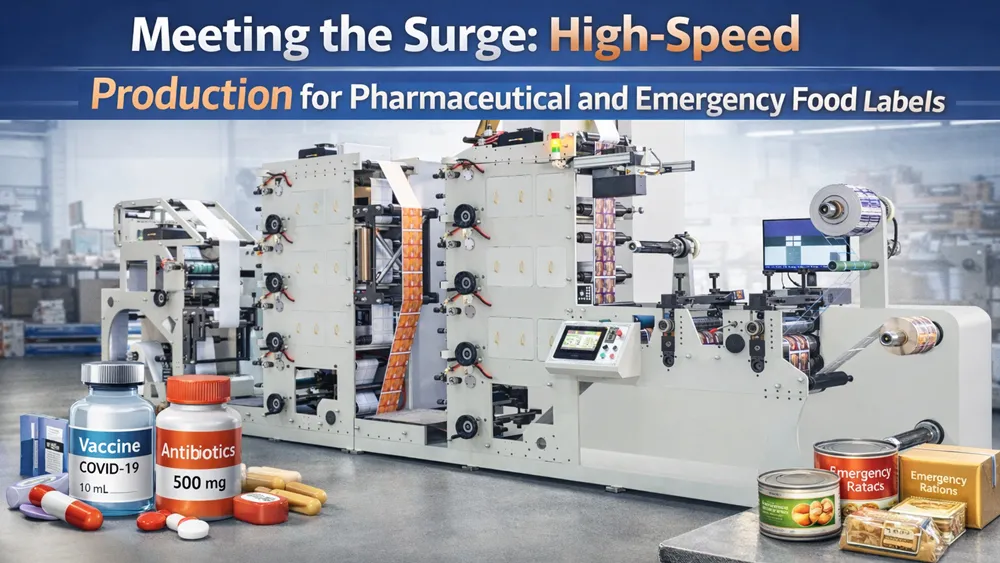
Modern Gearless CI Flexo Press are designed for high-efficiency label production, allowing multiple printing processes to be completed in a single production pass.
This one-pass production workflow dramatically increases manufacturing efficiency.
High-Speed Industrial Label Printing
High-speed flexo presses can operate at 100–200 meters per minute, depending on configuration.
For label converters, this means:
-
Faster order fulfillment
-
Higher production output
-
Reduced production bottlenecks
This production capability is especially important for:
-
Vaccine label printing
-
Pharmaceutical bottle labels
-
Emergency food packaging labels
Multi-Color Printing in One Production Run
Medical and food labels typically contain multiple design elements.
These include:
-
Product information text
-
Multi-language instructions
-
Regulatory compliance symbols
-
Barcodes and QR codes
-
Brand identity graphics
Flexographic printing machines can complete multi-color printing in one pass, eliminating the need for repeated printing cycles.
Flexible Material Compatibility
Another advantage of flexographic printing technology is its compatibility with a wide range of label materials.
Typical substrates include:
-
Adhesive labels
-
BOPP labels
-
PP films
-
PE films
-
PET films
-
Coated paper
-
Thermal label paper
This versatility allows converters to quickly switch between pharmaceutical packaging and food packaging applications.
Production Efficiency Example: Flexo Printing Output
To understand the efficiency of flexographic printing, consider a typical production scenario.
A flexographic press running at 150 meters per minute producing labels with a repeat length of 250 mm can theoretically produce:
36,000 labels per hour
With optimized production workflows, converters can reach even higher output levels.
This production capacity allows packaging suppliers to fulfill large emergency orders in a short timeframe.
Strengthening Packaging Supply Chains
Reliable packaging production plays a critical role in ensuring that medicines and emergency food products reach their destinations without delays.
High-efficiency printing equipment helps packaging manufacturers:
-
Increase production capacity
-
Reduce order lead times
-
Maintain consistent label quality
-
Improve operational reliability
By investing in advanced printing technology, manufacturers can build more resilient packaging supply chains capable of responding to sudden demand surges.
Flexographic Printing Solutions from Newtop Machinery
Newtop Machinery specializes in manufacturing flexographic printing machines and label converting equipment for industrial packaging production.
Our flexo presses are widely used for:
-
Pharmaceutical label printing
-
Food packaging labels
-
Adhesive labels
-
Film and paper label materials
Key advantages include:
-
High-speed one-pass printing technology
-
Flexible machine configurations
-
Stable industrial production performance
-
Customizable machine specifications for different materials and label sizes
With years of engineering experience in printing and packaging machinery, Newtop Machinery helps label converters improve production efficiency and respond quickly to changing market demands.
Conclusion
In times of crisis, efficient packaging production becomes a crucial part of the global supply chain for pharmaceuticals and emergency food supplies.
High-speed flexographic printing machines enable packaging manufacturers to respond rapidly to urgent orders while maintaining strict quality and regulatory standards.
For converters seeking to increase their production capacity and strengthen supply chain resilience, investing in advanced flexographic printing technology offers a practical and scalable solution.
Frequently Asked Questions
What printing technology is commonly used for pharmaceutical labels?
Flexographic printing is widely used in pharmaceutical label production because it provides high speed, precise color registration, and compatibility with various label materials.
Can flexo printing machines handle food packaging labels?
Yes. Flexographic printing machines are commonly used for food packaging labels, including labels printed on BOPP, PET, PP, and adhesive paper materials.
Why is one-pass printing important for high-volume label production?
One-pass printing allows multiple colors and processes to be completed in a single run, which significantly increases production speed and reduces manufacturing time.
What production speed can flexographic printing machines achieve?
Modern flexographic printing machines can operate at 100–200 meters per minute, depending on machine configuration and material type.
Learn more about our
flexographic printing machines for label production.
See how label die cutting machines improve production efficiency.